Art scanning
Studio-grade artwork scanning, with best-effort colour matching.
High-resolution digitisation of original artwork for reprints, licensing, and archival records. Flatbed-first workflow with optional colour matching to get reprints as close to the original as our equipment can manage. Some colours, like fluorescents, sit outside what pigment-ink printers can reproduce, we'll flag those upfront.
5.0 80 reviews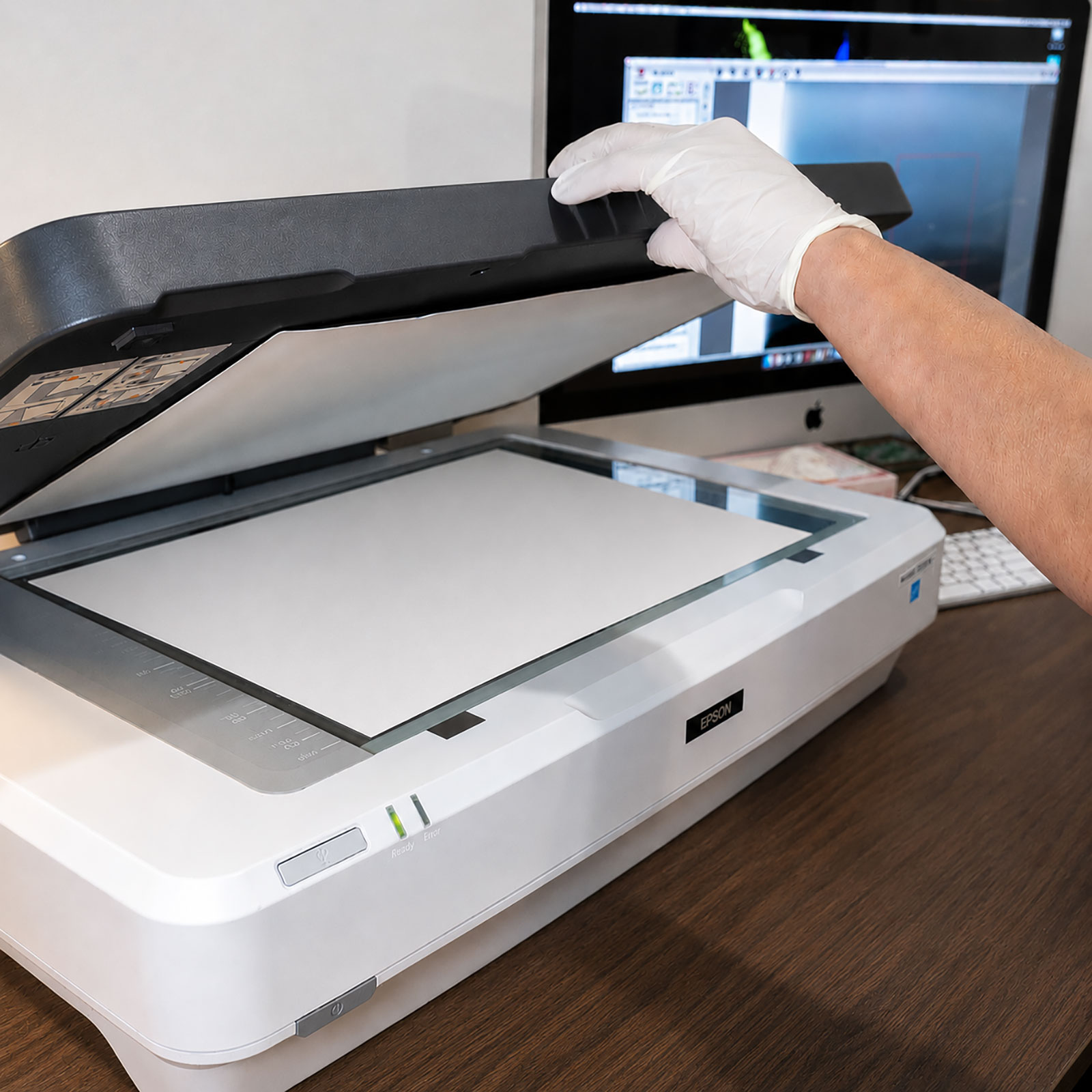
Why scan with us
Built for reproduction, not capture.
We scan artwork the way printers want to receive it. Flat, sharp, and tuned for colour as carefully as we can manage, in a format that gives your reprint the best chance of looking like the original.
- 01
Flatbed first, camera only when we have to
We always prefer flatbed scanning for accuracy and detail. Photographing introduces lens distortion, lighting variance, and reflection. We only switch to camera capture when an artwork is too large to scan in pieces.
- 02
Colour matching, best effort
We work hard to get reprints close to the original. The workflow includes scan calibration, test prints on related media, and file adjustments based on what comes off the printer. We can't guarantee a perfect match, since pigment ink printers have limits (more on that below) and any printer or media swap downstream changes the result. What we can do is get visibly close, on our own equipment.
- 03
Print-ready files, your formats
TIFF or JPEG at the resolution your reprint needs. RGB or sRGB on request. We hand the files over and they're yours, we don't watermark, retain rights, or repurpose your work.
Estimate the cost
Get a price now.
Pick the size of your original and whether you need calibrated colour matching. Submit photos for an exact quote, condition and surface texture can shift the workflow.
Restoring an old photo instead? See photo restoration →
Please input the height and width below to get a rough estimate for your restoration.
Please input the height and width below to get a rough estimate for your scan.
Anything larger than 120 cm on either side needs a custom quote, that's where our workflow shifts to camera capture.
Pick a size and we'll estimate the price.
Estimate
—
Estimate only. Submit photos for an exact quote. Every job is different and condition matters more than size.
Oversize
Custom quote
Anything larger than 120 cm on either side needs a custom quote, that's where the workflow shifts to camera capture. WhatsApp us photos and dimensions.
Who it's for
Common use cases.
The output we produce works for any flow that ends in a printed reproduction or a licensable digital asset.
- Original paintings being turned into a print run
- Illustrators digitising work for licensing or print-on-demand
- Galleries and dealers cataloguing inventory
- Estates digitising a deceased artist's body of work
- Insurance archives that need accurate visual records
What's next
Print from your scan.
Once you've approved the digital file, we can run reprints with the same colour pipeline that produced the scan. Same studio, no handover, the print matches the source.
FAQ
Common questions.
If yours isn't here, send us a photo and dimensions, we'll come back with a steer.
-
What format do you deliver, and at what resolution?
TIFF or JPEG at 300 PPI relative to the original size as standard, higher on request. We can also export specifically sized for a target print (e.g. "300 PPI at 60 × 80 cm"). RGB by default; we can convert to sRGB or a specific ICC profile if your printer needs one.
-
Do I retain copyright and ownership of the files?
Yes, completely. We're providing a digitisation service. The files are yours from the moment we deliver them. We don't watermark, register, license, or reuse your work in any way.
-
What's colour matching, and is it always needed?
Colour matching is our best-effort process for getting a reprint as close to the original as we can. We do scan calibration, run test prints on related media, and adjust the file until the printed result reads as close to the source as practical. It can be a time intensive process depending on the image and this coupled with having to run prints on real media is why we charge $150. Important honest caveat: we can't guarantee a perfect match. Even with careful work the result depends on the printer, the inks, and the substrate, and not every colour in the original is reproducible (see the next question). You also need to be mindful that colour corrected prints may not look "right" on your monitor simply because your monitor is not calibrated or even capable of seeing all the different colours in a file. There is also times where certain colours need to be fundamentally altered to show up in a print, but can make the digital file feel "off" even if the print output is a match for the original.
-
Can you reproduce every colour in my artwork?
Not always, no. We print using high-end pigment ink printers from Canon. These sort of machines are specially designed for fine art printing and they produce exceptional results and details, but they have limitations too. Some colours may fall outside of what is possible to print. Some colours may even fall outside of what image editing software can reproduce. In these instances software and printers choose the "closest alternative" and this sometimes is good enough and sometimes requires further adjustments. One area that pigment ink machines are not great at capturing is really fluorescent colours. In these situations we can capture those sorts of colours but we probably can't reproduce them on our printers. You could probably take your files though and work with a UV printer to produce those fluorescent tones.
-
If I take your file to another printer, will the colour still match?
Its unlikely to be a perfect match. Colour matching is tied to the printer, the ink, and the media being used. We tune your files to look right on our equipment and with the media we stock. A different printer may not even bother with colour management or they may simply have vastly different equipment and media. The results could therefore differ substantially. If you plan to print elsewhere, just let us know upfront and we can probably share with you a PSD file with the adjustment layers included.
-
What's the largest size you can scan?
Theres not really a size limitation as such but our flatbed scanner does max out at A3 size. This is unfortunately a common limitation with high resolution scanners, so if that sounds small to you, we agree. What we usually do beyond A3 size is create multiple scans of the item and then stitch them together in Photoshop. It works very effectively and enables us to scan and handle much bigger works without having to go down the route of photography. Generally we try not to photograph, though we do have a proper studio set-up when required. In our experience the flatbed scanning route provides the sharpest and most accurate output and also enables us to upscale better if you want to increase the size of the original in the future.
-
How long does it take?
Single-piece A3 with colour matching: typically 3 to 5 working days. Larger pieces or batches take longer because of the stitching and review steps. We confirm a turnaround when we quote.
-
Can you also print from the file you make?
Yes. Many clients keep the workflow under one roof: we scan, you approve the file, and we print on archival paper or canvas. Same colour pipeline end to end, so the printed result matches what we delivered digitally.
Visit & contact
Get in touch or come visit us.
Hours
- Mon - Fri
- 10am - 6pm
- Saturday
- 10am - 5pm
- Sun & PH
- Closed
Other ways to reach us
Already messaging us on WhatsApp or email? It's often quickest to continue there. If you call, the person answering may need a moment to review your earlier correspondence.
Thanks, message received.
We'll reply by email the same working day. If it's urgent, give us a WhatsApp on +65 8875 3330.